
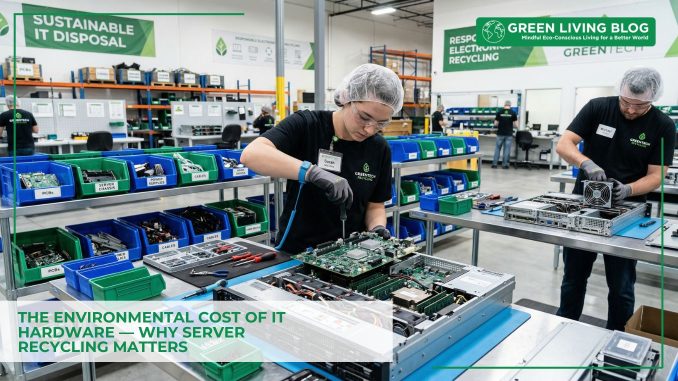
But there is another waste stream growing quietly in the background, one that most people never see and rarely think about: electronic waste from IT hardware.
Specifically, the servers, computers, and networking equipment that power everything from your online banking to your favourite streaming service. When that hardware reaches end of life, it must go somewhere.
And where it ends up matters far more than you might think.
The Scale of the Problem
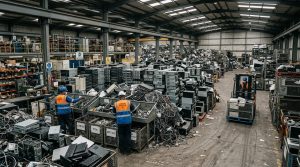
The UK generates around 1.5 million tonnes of electronic waste every year, making it one of the largest e-waste producers per capita in the world. A significant chunk of that comes not from household gadgets but from business and enterprise IT equipment — servers, desktop computers, laptops, and networking infrastructure that gets cycled out every three to five years.
A single server rack can contain dozens of individual machines, each packed with circuit boards, rare earth metals, copper, aluminium, and plastics. When a data centre refreshes its hardware or a business upgrades its systems, hundreds or even thousands of these units need to be dealt with at once. Multiply that across every company in the country and you start to see the scale of the challenge.
The tragedy is that much of this equipment still ends up in landfill or is exported to developing countries where it is broken down in unsafe conditions, leaching toxic materials like lead, mercury, and cadmium into soil and groundwater. It is an environmental and human health disaster that rarely makes the headlines.
What Is Server Recycling, and Why Does It Matter?
Server recycling is exactly what it sounds like — the process of responsibly decommissioning, dismantling, and recovering materials from end-of-life servers and IT equipment. But responsible recycling goes well beyond simply stripping out the copper and binning the rest.
A proper computer recycling process involves several stages. First, certified data destruction ensures that any sensitive information stored on hard drives and solid-state drives is permanently and verifiably erased. This is critical for businesses handling customer data, financial records, or proprietary information. Industry-standard tools like Blancco-certified data wiping provide an auditable trail proving that data has been destroyed beyond recovery.
Next comes the material recovery phase. Modern servers contain a surprising range of valuable and finite resources. Gold, silver, palladium, and platinum are all used in circuit board manufacturing. Copper wiring, aluminium heat sinks, and steel casings can all be smelted and reused. Even the plastics can be processed and fed back into manufacturing supply chains. When done correctly, server recycling can recover upwards of 95 percent of the materials in a machine, dramatically reducing the need to mine virgin resources.
This is the circular economy in action — not as an abstract concept, but as a practical, measurable process that keeps finite materials in use and out of the ground.
The Carbon Footprint You Do Not See
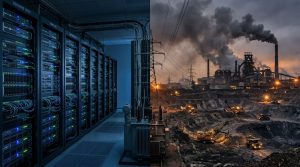
Here is something that often surprises people: the majority of a computer’s carbon footprint comes not from using it, but from manufacturing it. The mining, refining, fabrication, and global shipping involved in producing a single server generates a substantial amount of CO2 before it is ever switched on.
This is why recycling and material recovery matter so much from a climate perspective. Every kilogram of aluminium recovered from an old server is a kilogram that does not need to be smelted from raw bauxite — a process that is extraordinarily energy-intensive. Every gram of gold reclaimed from a circuit board is a gram that does not require destructive open-pit mining.
When we recycle IT hardware properly, we are not just keeping waste out of landfill. We are actively reducing the demand for some of the most carbon-intensive industrial processes on the planet.
What Can Businesses and Individuals Do?
If you run a business, the single most impactful step you can take is to work with a certified IT recycling provider when decommissioning old equipment. Look for companies that offer a zero-landfill guarantee, certified data destruction, and transparent reporting on what happens to your hardware after collection. Many providers, including those operating across the UK, offer free nationwide collection, which removes the cost barrier entirely.
For individuals, the same principles apply on a smaller scale. Do not let old laptops and desktops gather dust in a cupboard or, worse, throw them in the general waste. Most local councils offer e-waste collection points, and many computer recycling services in the UK accept equipment from households as well as businesses.
It is also worth thinking about this issue as a consumer. When choosing service providers, hosting companies, or even employers, consider asking about their IT disposal policies. Companies that take e-waste seriously tend to take their broader environmental responsibilities seriously too.
The Bigger Picture
The conversation around sustainability is rightly broadening beyond the obvious culprits. We are getting better at understanding that our digital lives have physical consequences — from the energy consumed by data centres to the raw materials embedded in our devices.
Server recycling and responsible IT disposal are not glamorous topics. They do not generate the same emotional response as images of plastic-choked oceans or deforested hillsides. But they are a critical piece of the sustainability puzzle, particularly as our dependence on digital infrastructure continues to grow year on year.
The good news is that the infrastructure and expertise to handle this problem already exist in the UK. The challenge now is awareness — making sure that businesses and individuals understand that there is a better option than landfill, and that choosing it is easier than they might expect.
Every server that gets properly recycled is a small victory for the circular economy. And those small victories, repeated thousands of times across the country, add up to something genuinely meaningful.

Author Profile

- Passionate content creator, contributor, freelance writer and content marketing allrounder.
Latest entries
 Green Expert GuidesMarch 28, 2026The Environmental Cost of IT Hardware — Why Server Recycling Matters
- DictionaryFebruary 26, 2026Geothermal Plants – The Solution to Lower Carbon Energy?
- BusinessFebruary 20, 2026How Sustainable Businesses Navigate Complex Payment Processing Challenges
- DictionaryFebruary 13, 2026What is Climate Change Evidence?




Leave a Reply
You must be logged in to post a comment.