
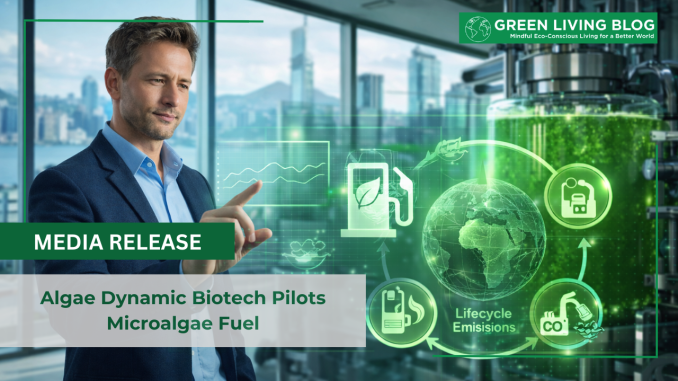
Hong Kong pilot turns engineered microalgae into a drop-in renewable fuel for diesel fleets and generators, pairing duty-cycle tests with assurance-ready lifecycle reporting and partner frameworks designed to support scale-up finance into 2026.
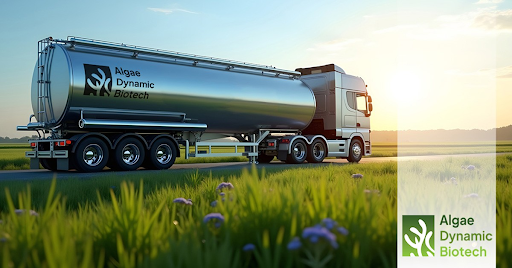
Industrial operators that rely on diesel for heavy transportation, marine workboats and stationary power generation are tightening procurement rules around lifecycle emissions, and a Hong Kong pilot is using engineered microalgae to produce an algae-based biofuel designed as a drop-in renewable fuel for existing engines.
Peng Li, Algae Dynamic Biotech Limited Pte. Ltd.’s CEO, sets the priority as operational continuity:
“Industrial customers want lower lifecycle emissions without downtime or costly equipment change, so our focus is on fuels that behave like diesel in the engine while looking very different in lifecycle carbon data.”
The programme remains in pilot and on a commercialisation pathway, with a limited group of industrial partners supplying duty-cycle data from mining haulage, construction equipment, logistics fleets, marine auxiliaries and generator sets. The company focuses on applications where electrification and hydrogen can be constrained by payload, refuelling intervals or continuous operation, and it is testing blends that aim to avoid changes to injectors, filters or storage practices.
Technical work centres on microalgae because engineered strains can be selected for elevated lipid content and stable growth, while cultivation can sit on non-arable land and use non-potable water such as brackish streams or treated wastewater. Where site conditions allow, the pilot integrates concentrated CO2 streams as a carbon input, tracking flows from cultivation through extraction and refining so that partners can assess the closed-loop carbon cycle using consistent assumptions.
In screening data gathered over the preceding 12-month period to December 2025, the company reports brake power within 1 to 10% of a mineral diesel baseline for B20 through B50 blends on the same engines and comparable loads, while particulate matter trends 30 to 40% lower on the tested duty cycles. A preliminary well-to-wheel assessment completed over the same preceding 12 month period indicates 50 to 70% lower lifecycle greenhouse-gas intensity than petroleum diesel under a defined scenario that uses concentrated CO2 inputs and low-carbon electricity for cultivation and processing, and Mr. Li links the reporting to compliance needs:
“Every litre of fuel is now benchmarked against emissions limits and total cost of ownership, so we design our algae-based biofuel to slot into existing testing protocols and regulatory frameworks.”
Alongside engine work, Algae Dynamic Biotech Limited is packaging results into standardised technical data rooms, consistent ESG metrics and assurance-ready lifecycle reporting built for independent verification, a structure intended to match the due diligence expectations that institutional energy and infrastructure investors, long-horizon capital and specialist cleantech funds apply when they assess whether pilots can scale, and it is standardising documentation and change control so that external assurance can expand as volumes grow. A small partner group is also helping to shape technical validation and early commercial frameworks, aligning measurement boundaries, fuel specifications and verification steps so future projects can be compared across sites, and Mr. Li frames the discipline as a prerequisite for growth:
“If the data cannot stand up to independent verification, scale does not follow.”
Cost and throughput remain decisive constraints for microalgae-derived fuels, and the pilot evaluates a biorefinery model that credits co-products and services alongside fuel, including protein-rich residual solids and wastewater treatment integration where inputs and permits align. In a techno-economic model developed over the preceding 6 month period to December 2025 for pilot-scale configurations, co-products priced at about $276 to $578 per tonne are used to model an indicative minimum fuel selling price shifting from about $8.39 per gallon of gasoline equivalent in a fuel-only case to about $2.63 per gallon of gasoline equivalent when co-product credits are applied, with outcomes varying by site energy mix during the model period.
Over the next two quarters and into 2026, Algae Dynamic Biotech Limited expects to widen partner trials across heavy transportation, marine and power generation and commission third-party verification and assurance protocols as it moves towards demonstration-scale evidence and commercial frameworks.
About Algae Dynamic Biotech Limited
Algae Dynamic Biotech Limited is a Hong Kong–registered company specialising in algae based renewable fuels for agricultural and industrial operations. The company follows a three-stage process: cultivation of selected algae, extraction and refinement using advanced methods, and application in heavy machinery. Its fuels are engineered for performance in demanding environments while reducing emissions through eco-certified, zero-waste processes. With global distribution capabilities, Algae Dynamic Biotech positions itself as a trusted partner in delivering measurable results, operational reliability, and sustainable progress worldwide.
Press contact: Ke Wang, media@algaebiofuel.com. Learn more at https://algaebiofuel.com.

Author Profile

- Always on the hunt for the latest green living news, tips and stories, proudly sharing them with readers all around the world to make this planet a better place.
Latest entries
 Green Home GuidesFebruary 27, 2026How Weather Measuring Tools Can Help Create Thriving Biodiverse Outdoor Spaces
- Green News ReleasesFebruary 14, 2026Algae Dynamic Biotech Parses 45Z Credit Rules
- DictionaryJanuary 19, 2026What is Microplastics Pollution & How to Avoid Microplastics
- Green Expert GuidesJanuary 17, 2026Could going flight-free be the best decision you make this year?




Leave a Reply
You must be logged in to post a comment.