
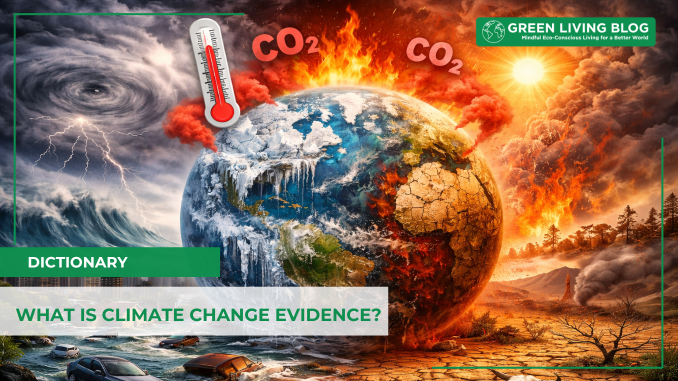
Climate change evidence can be considered any scientific evidence for warming of the climate system on earth.
There is now overwhelming scientific consensus across the UK and globally that the world’s climate is changing at an unprecedented rate.
Average global surface temperature has increased by between 1.34°C and 1.41°C compared to pre-industrial times, and nearly all of this warming has happened since the 1970s.
The Intergovernmental Panel on Climate Change (IPCC), regarded by the UK government as the gold standard for climate science, states that human activities, mainly the burning of fossil fuels, are responsible for almost all this warming.
Atmospheric carbon dioxide levels are now higher than at any point in at least two million years, based on detailed ice-core data. (IPCC)
Sea levels are also rising, with the global average up by about 20 centimetres since 1901.
However, the climate change evidence is constantly being debated due to many unknown factors that can’t be traced back to compare earth’s climate change journey throughout time.
Also read: The Fossil Fuel Impact of the COP28 Climate Deal on Climate Change
Key UK Authorities That Provide Climate Change Evidence

In the UK, climate change evidence comes from several trusted, independent authorities.
The UK government’s climate science guidance pages pull together the latest peer-reviewed research and official assessments and referencing IPCC findings as the global benchmark. (UK Government)
The Met Office Hadley Centre is the UK’s national hub for climate monitoring, modelling, and analysis. Its annual “State of the UK Climate” reports provide a vital, data-driven snapshot of the UK’s changing climate, where it tracks temperature, rainfall, and extreme weather trends over time. (Met Office)
The independent Climate Change Committee (CCC), established under the Climate Change Act 2008, assesses climate risks and reports annually to Parliament on the UK’s progress in both reducing emissions and adapting to impacts. The CCC’s five-yearly UK Climate Change Risk Assessments are required by law and set out priority risks and actions for government and industry. (Climate Change Committee)
Observed Climate Change Evidence in the UK
In 2025, the UK experienced its hottest and sunniest year ever recorded. Both temperature and sunshine hours hit new all-time highs (Met Office).
The UK has been warming at a rate of about 0.25°C each decade since the 1980s, according to long-term weather records (Met Office).
The weather is not just hotter but also more unpredictable.
From October 2023 to March 2024, England and Wales had their wettest winter in over 250 years (Climate Change Committee). But just months later, parts of the country faced drought conditions in 2025, which shows how quickly things can change (UK Government).
Trees in 2024 kept their leaves for seven days longer on average compared to the previous 25 years, a clear sign of a lengthening growing season (State of UK Climate).
Consumer Opinions and Public Sentiment On Climate Change Evidence
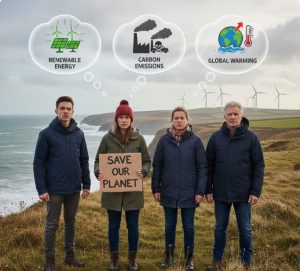
Public concern on climate change is high, but confidence in action is much lower.
In summer 2025, 79% of people in the UK said they were worried about climate change (UK Government). Almost everyone (91%) has heard about the UK’s “Net Zero by 2050” goal, but only just over half (53%) felt they understood what it actually meant.
Many people doubt whether the government will deliver on its targets, and economic worries are a major reason why. Some believe going green will be too expensive or difficult for ordinary households (UK Government).
There’s also a gap between general support for green energy and support for it locally.
While 80% of people in the UK support renewables in principle, only 35% say they would welcome an onshore wind farm near their home. (Department for Energy Security and Net Zero)
The UK’s Climate Law and Policy Framework

The UK was the first country to make fighting climate change a legal obligation.
The Climate Change Act 2008 set legally binding targets to cut carbon emissions (Wikipedia). This was toughened in 2019, requiring the UK to reach “Net Zero” emissions by 2050.
The Act works through “carbon budgets”, which are five-year limits on the total emissions allowed. These caps are set based on up-to-date climate science and advice from independent experts (Climate Change Committee).
Importantly, the law requires a full Climate Change Risk Assessment (CCRA) every five years, which checks for risks like flooding, heatwaves, and drought. (UK Government PDF)
The next major risk assessment is scheduled for 2026 (UK Climate Risk).
If the government misses targets or ignores the evidence, campaigners can use the law to hold them to account (Net Zero Compare).
Climate Change Evidence – Common Misconceptions and Refutations
Some people believe the current warming is down to solar activity or natural cycles, but scientists have ruled this out with strong evidence. (Met Office)
While the Earth’s climate has changed before, the current rate of change is far faster than anything in the past (based on the data available). (NASA)
It’s also a myth that scientists are divided: over 99% of published climate research agrees that humans are the main cause of recent warming. (Met Office)
Some say carbon dioxide can’t have much effect because it’s just a “trace gas,” but even small amounts have a big impact on global temperature. (Royal Society).
Finally, climate models are dismissed as guesswork, but they have repeatedly proven accurate in predicting temperature trends. (Met Office)
Want to Dig Deeper? More Resources
- UK Climate Projections (UKCP18) User Interface
- Met Office Climate Data Portal
- British Geological Survey: Geoclimate Datasets
- Climate Reports | United Nations
If you have new UK data, insights or trends to contribute to the climate change evidence debate, get in touch with us.
Disclaimer: All the information provided was correct at the time of publication (January 2026) and was collected with the help of accredited tools and AI.

Author Profile

- Passionate content creator, contributor, freelance writer and content marketing allrounder.
Latest entries
 Green Expert GuidesMarch 28, 2026The Environmental Cost of IT Hardware — Why Server Recycling Matters
- DictionaryFebruary 26, 2026Geothermal Plants – The Solution to Lower Carbon Energy?
- BusinessFebruary 20, 2026How Sustainable Businesses Navigate Complex Payment Processing Challenges
- DictionaryFebruary 13, 2026What is Climate Change Evidence?



Leave a Reply
You must be logged in to post a comment.