
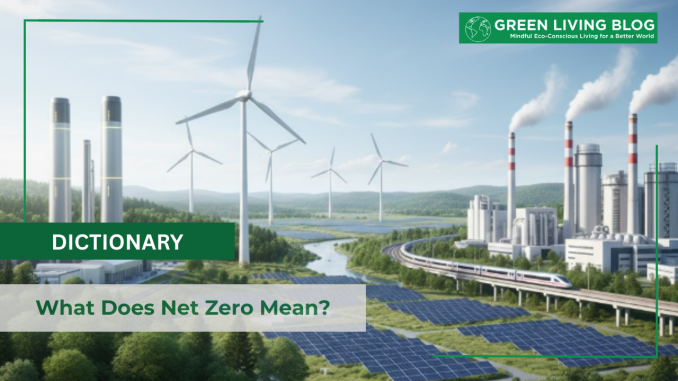
Net zero means balancing the greenhouse gases we put into the air with the amount we remove, so that overall, our emissions are zero or less (Institute for Government).
“Net Zero” — Official UK Definitions

‘Net zero’ refers to the UK Government’s legal commitment to reduce its net greenhouse gas emissions to zero by 2050. (Commons Library)
This is not the same as “gross zero,” which would mean stopping all emissions completely (a step that isn’t practical, since industries like farming and aviation will always produce some emissions).
Instead, net zero recognises that we’ll have “leftover” emissions from these sectors, so we must remove an equal or greater amount from the atmosphere.
This removal is done by natural carbon sinks, such as forests, or by using technology like carbon capture. (UK Climate Change Act)
Progress is tracked by the “net UK carbon account,” which balances what we emit with what we remove, including adjustments for carbon traded internationally. (UK Government: Net Zero Legislation)
Also read: 8 Best Ways to Reduce Your Carbon Footprint
Origins and Legislative Evolution of Net Zero
The UK’s journey on climate action began in the 1990s, following the United Nations’ first big climate agreement in 1992. (UK Parliament Library)
The Climate Change Act 2008 then made the UK the first country in the world to set legally binding long-term emission targets, with the aim at first for an 80% reduction in greenhouse gases. (Climate Change Committee)
In 2019, the law was updated to require net zero emissions by 2050, which makes the UK the first major economy to make this a legal requirement. (UK Parliament Research Briefing)
The UK’s Legally Binding Target Framework
The UK manages its route to net zero through “carbon budgets”.
These budgets place a strict cap on the UK’s total emissions for each five years, set at least 12 years in advance. (UK Government Carbon Budget Report).
Each new budget gets more ambitious.
- The Sixth Carbon Budget (covering 2033–2037) requires a 78% cut in emissions compared to 1990 and, for the first time, includes international aviation and shipping. (GOV.UK)
- The Seventh Carbon Budget, planned for 2038–2042, is due to be set in law by 2026 and aims for an 87% reduction. (Climate Change Committee)
How Close is the UK to Net Zero Today?
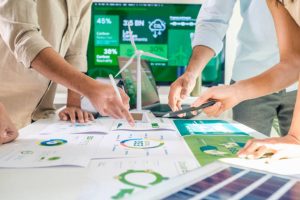
By late 2025, the UK had become the first major economy to halve its emissions compared to 1990 levels, even while growing its economy significantly. (UK Government Emissions Statistics)
Most of this progress is thanks to cleaner energy, especially since the last coal power station closed in September 2024. (Climate Change Committee)
However, some areas, such as farming, have barely changed: agricultural emissions have remained stuck at around 48–49 million tonnes of CO₂ equivalent for over ten years. (UK Agri-Climate Report)
Influence of Net Zero on UK Businesses
Net zero targets now affect how UK companies do business, especially with the public sector. Any business bidding for a central government contract over £5 million a year must have a clear Carbon Reduction Plan. (UK Government Procurement Note)
However, even with these rules, there are gaps: regional studies find many firms are still not fully engaged. (Leicestershire Climate Action Network)
Finance experts have also found that a lack of financial detail in some sector plans makes green investment risky and difficult for private investors. (Responsible Investor)
Further Sources
- UK Government – Net zero strategy and policy
- Office for National Statistics – Net zero data
- UK Climate Change Committee – Independent progress tracking
- National Grid – Net zero explainer
- Commons Library – UK net zero briefing
- IPCC – Global scientific context
If you have new UK data, community projects, or green tech to support the UK government’s Net Zero goals, get in touch to share your story.
Disclaimer: All the information provided was correct at the time of publication (January 2026) and was collected with the help of accredited tools and AI.

Author Profile

- Passionate content creator, contributor, freelance writer and content marketing allrounder.
Latest entries
 DictionaryFebruary 26, 2026Geothermal Plants – The Solution to Lower Carbon Energy?
- BusinessFebruary 20, 2026How Sustainable Businesses Navigate Complex Payment Processing Challenges
- DictionaryFebruary 13, 2026What is Climate Change Evidence?
- DictionaryFebruary 4, 2026What Does Net Zero Mean?

Leave a Reply
You must be logged in to post a comment.