

Between April 2024 and March 2025, commercial-scale fly-tipping (“tipper lorry load size or larger”) spiked by 11% to roughly 52,000 incidents in England.
It’s not a new but a growing problem!
The UK government has realized that simple Fixed Penalty Notices (FPNs)—which currently charge up to £600 for a breach of household “duty of care”—are no longer a sufficient deterrent for large-scale operations.
In response, the UK’s March 2026 Waste Crime Action Plan and broader legislative overhauls have introduced aggressive proposals to penalise offenders and tighten oversight.
But the question is: is penalising illegal waste disposal solving the issue or is there a better solution?
The UK’s Waste Crime Action Plan: What’s Changing?
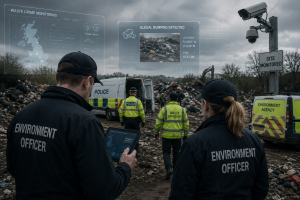
- Mandatory Digital Waste Tracking (October 2026): This upcoming compulsory system will require all waste-receiving sites to digitalise their data, making it incredibly difficult for rogue, unlicensed waste carriers to slip through the cracks.
- Driving Licence Penalties: The government is exploring adding penalty points directly to offenders’ driving licences for waste crimes, hitting rogue traders where it hurts their business most.
- Conditional Cautions & Unpaid Work: New penal structures will lean heavily on conditional cautions that mandate fly-tippers to perform unpaid community service—specifically clearing up environmental waste.
- “Naming and Shaming”: The Action Plan explores frameworks to publicly name persistent environmental offenders to create a social deterrent.
It’s clear that these measures don’t target what lies at the heart of illegal fly-tipping: that people don’t want to pay for disposing of their waste.
The cleanest way to fight fly-tipping is to build a society where waste is too valuable—or too easy to dispose of—to dump illegally.
The proof can be found in countries not far from Britain! According to data from the European Environment Agency, who tracks municipal waste landfill rates across the continent, some European countries still landfill over 70% of their waste, while Sweden, Belgium, and Finland have successfully reduced their landfill rates to 0%.
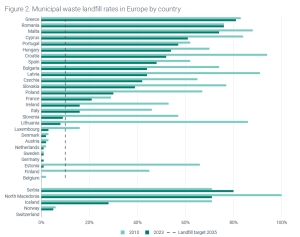
How did they do it? It’s not magic, it’s common sense combined with smart technology!
High-Efficiency Energy from Waste Vs. Waste Crime Action
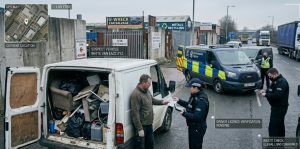
In Sweden, strict sorting combined with an incredibly advanced network of waste-to-energy plants means that trash is treated as a high-demand commodity. Because the infrastructure seamlessly absorbs waste at zero friction to the consumer, the local economic incentive for household or minor commercial fly-tipping is entirely choked out.
The core reason the above countries have successfully reduced their landfill rates to virtually 0% is that they do not just burn trash to get rid of it; they integrate the process entirely into their national energy grids.
Why is this not happening in the UK?
The Waste-to-Energy (WtE)—or Energy from Waste (EfW)—infrastructure model is frequently misunderstood as just “glorified incineration”, but is already in place all over the UK. When executed to the standard of countries like Sweden, Finland and Belgium, it is a highly sophisticated thermodynamic and environmental system that treats residual, non-recyclable trash not as a liability, but as a high-value energy asset.
So what’s going wrong in the UK with EfW?
The UK’s EfW Reality vs. The Continental Model
The UK does not actually lack WtE plants; major operators like Viridor with EfW plants all over the UK handle millions of tonnes of residual waste annually, and the country has aggressively transitioned away from traditional landfill.
However, the element that makes Sweden, Finland and Belgium world-class is Combined Heat and Power (CHP) coupled with District Heating Networks.
While a standard UK power station vents its leftover thermal energy into the atmosphere as giant clouds of steam, a Continental CHP plant captures that heat. It pumps hot water through massive, insulated underground pipe networks directly into residential radiators and commercial HVAC systems across entire cities.
This approach elevates the energy efficiency of the plant from a mediocre 20–25% (electricity only) to an incredible 85–90% thermal efficiency.
The UK infrastructure suffers from two major structural bottlenecks:
- Electricity-Only Focus: Most UK plants were built in isolated industrial areas, far from major cities. Without nearby thermal customers, they cannot run district heating networks and must vent their valuable heat.
- The 2026 Regulatory Pivot: The economic landscape for UK plants is shifting rapidly. The UK Emissions Trading Scheme (ETS) launched its voluntary Monitoring, Reporting, and Verification (MRV) phase for the waste sector, ahead of mandatory carbon-tax pricing. Because burning plastic releases fossil-based CO2, UK plants face impending financial penalties unless they radically clean up their fuel source.
What the UK Needs to Fight Waste Crime for Good
For the UK to successfully scale a high-efficiency WtE model, it requires a systemic overhaul across planning, infrastructure, and supply chains.
1. Mandatory Siting and District Heat Networks

The UK cannot achieve true WtE efficiency until it mandates smarter infrastructure siting. Future plants must be built close to high-density heat demands.
- The Blueprint: Local authorities must be given the power and funding to lay down municipal district heating networks.
- Alternative Heat Sinks: Plants can also be co-located with modern, energy-intensive infrastructure—such as the data center clusters currently surging across the UK—using the excess thermal energy to power and regulate industrial cooling systems.
2. Radical “Upstream” Plastics Extraction
To survive under the UK ETS rules, the composition of the waste entering the incinerator must change. Burning organic food waste or wood is considered carbon-neutral, but burning plastic is not.
- The Blueprint: The UK must mimic Wales’ regulatory updates, which enforce strict source-segregation of plastics and electronic waste for all businesses. By removing plastics before they reach the WtE facility, the UK can slash the carbon tax liability of the plants, keeping them economically viable.
3. Retrofitting Carbon Capture and Storage (CCS)
Because the UK is aiming for deep decarbonization, simply burning waste efficiently is no longer enough; the plants must actively prevent emissions from escaping.
- The Blueprint: The UK needs to heavily subsidize the integration of Carbon Capture and Storage (CCS) technology directly onto WtE smokestacks. By capturing the $CO_2$ from both the fossil (plastic) and biogenic (food/wood) fractions of the trash and burying it safely undersea, WtE facilities can actually become net-negative carbon emitters, effectively cleaning the atmosphere while managing municipal waste.
4. A Total Legislative Ban on Landfill
In Sweden and Belgium, landfilling organic or recyclable waste is illegal. This ban forces a predictable, steady volume of feedstock directly into the recycling and WtE pipelines, providing investors with the financial certainty needed to fund these incredibly capital-intensive facilities. The UK must phase out the remaining reliance on landfill to completely close the loop.
Solutions are the Answer, not Punishment
The UK can decide to invest in better EfW infrastructure to make waste management useful, beneficial and cost-effective, especially when energy becomes increasingly costly. Policing waste crime has clearly not fought illegal fly-tipping. The data and case studies speak for themselves, so all it takes is the right initiative by key facilitators.

Author Profile

- Online Media & PR Strategist
- Blogger and Educator by Passion | Senior Online Media & PR Strategist at ClickDo Ltd. | Fascinated to Write Lifestyle Blogs in News & Education I have completed a journalism summer course at the London School of Journalism and manage various blogs.
Latest entries
 Green Home GuidesAugust 19, 2026Top 10 Eco Kitchen Accessories & Sustainable Alternatives
- UncategorizedAugust 7, 2026How Smarter Bin Bag Habits Can Stop Maggots in the Trash Can
- BusinessJune 30, 2026Top 10 Green Brands in the UK Market: Setting the Eco Standard
- DictionaryJune 23, 2026Outdoor Yoga is the “Triple-Win” Wellbeing Habit for the Self + Community + Planet




Leave a Reply
You must be logged in to post a comment.