
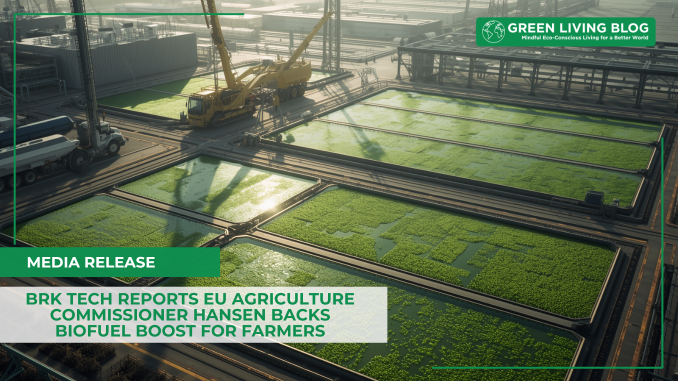
European biofuel rules are under scrutiny as grain prices squeeze farmers and policymakers weigh blending shifts, while BRK Technology’s microalgae strains enter pilot testing for drop-in renewable fuel for heavy machinery, marine and power.
With grain prices in European markets sitting around $189 to $201 a tonne in current trading, EU policymakers are weighing whether crop-based biofuel blending rules should flex when prices drop below roughly $236 a tonne, and today’s debate is opening space for alternatives that can expand renewable fuel supply without pulling land and food markets into conflict, including a microalgae pathway under development at BRK Technology.
The push, led by EU Agriculture Commissioner Christophe Hansen, centres on giving refiners more room to blend crop-derived fuels when farm economics are under strain, while still keeping sustainability guardrails intact. The policy tension is clear, crop fuels can support rural incomes and domestic fuel supply, yet they face scrutiny over indirect land-use change and the credibility of lifecycle greenhouse-gas accounting.
For industrial operators, the immediate issue is reliability, because construction, mining, marine and long-haul logistics cannot absorb fuel variability without operational risk, and rapid electrification remains uneven across duty cycles and geographies. In the most recently reported full year of EU road and rail energy statistics, conventional fuels still account for 93% of energy use, a reminder of how much heavy transportation and power generation still depend on liquid fuels.
The company is engineering microalgae strains to lift lipid content, then refining that biomass into an algae-based biofuel intended as a drop-in renewable fuel for existing engines, and it is launching pilot batches as the next step on a commercialisation pathway rather than a public product launch.
For Jin Wong, BRK Technology Co., Limited ’s CEO, credibility starts with field conditions, because:
“A fuel has to survive the duty cycle of heavy machinery, from a harvester to a loader, before it earns a place in serious procurement conversations”.
Microalgae offer a route to scale without crowding food crops, and published research reports oil yields that can reach around 50 tonnes per hectare per year in highly optimised systems, compared with roughly 0.5 tonnes per hectare per year for soybean oil, although results vary with strain selection, cultivation design and process energy.
Mr. Wong links that productivity to land and water flexibility and, in his words:
“We are building engineered strains for high lipid content on non-arable land and non-potable water, so operators can decarbonise without driving a new land-use problem”.
BRK Technology is using a limited set of early industrial partners to shape technical validation, fuel handling standards and commercial frameworks that match the realities of remote operations and tight maintenance windows, and it is formalising audit-ready reporting, consistent ESG metrics and independent verification plans that sophisticated infrastructure and specialist cleantech investors typically expect before backing scale-up.
Mr. Wong places the emphasis on governance as much as chemistry, because:
“Industry adoption is built on verified datasets, stable specifications and a governance trail that can stand up to independent review”.
Those pilots sit alongside a policy backdrop that is tightening around traceability, certification and the staged ramp for advanced biofuels through the compliance checkpoints that run to the end of the decade, while keeping caps on the share of food and feed crop biofuels in the transport energy mix.
Mr. Wong argues that a closed-loop carbon cycle needs that discipline and, as he puts it:
“The goal is to treat carbon as a managed input and to deliver a drop-in renewable fuel that meets the operational standards of heavy transportation and power generation, with lower lifecycle emissions that can be evidenced, not asserted”.
For industrial buyers tracking regulatory direction in real time, the signal is that pilots built around measurement and transparent governance are likely to set the template for broader deployment, especially in sectors that have limited near-term alternatives. As the blending debate sharpens, BRK Technology is positioning microalgae as one pathway that can broaden renewable fuel supply for heavy operations without hardwiring decarbonisation to politically contentious land constraints.
About BRK Technology
BRK Technology Co., Limited turns algae into drop-in renewable fuels built for the toughest industrial and agricultural machinery. From strain cultivation through advanced refinement to global delivery, every stage of production is eco-certified and zero-waste. Based in Hong Kong, the company partners with operators worldwide to cut emissions while maintaining the performance and reliability heavy operations require. Press contact: Calvin Lau, media@brktech.com | Website: https://brktech.com

Author Profile

- Always on the hunt for the latest green living news, tips and stories, proudly sharing them with readers all around the world to make this planet a better place.
Latest entries
 DictionarySeptember 3, 2026What Is Biodiversity Net Gain (BNG) in the UK? A Guide to Nature-Positive Development
- DictionaryJuly 10, 2026What Is the UK Deposit Return Scheme (DRS) & Extended Producer Responsibility (EPR)?
- Green News ReleasesApril 22, 2026BRK Tech Reports EU Agriculture Commissioner Hansen Backs Biofuel Boost for Farmers
- Green News ReleasesApril 17, 2026BRK Technology Tackles Energy Crisis with Biofuel Revolution


Leave a Reply
You must be logged in to post a comment.