
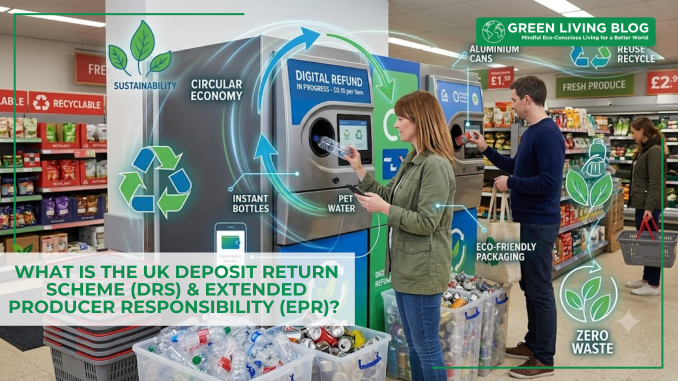
The UK is fundamentally reshaping how everyday grocery packaging is produced, paid for, and recycled. Through two massive policy updates—Extended Producer Responsibility (EPR) and the Deposit Return Scheme (DRS)—the cost of dealing with litter is shifting from local councils directly to the brands that produce the packaging.
For consumers, this means the way we shop, unpack, and handle household waste is about to undergo its biggest evolution in a generation.
Where Do These Packaging Changes Come From?
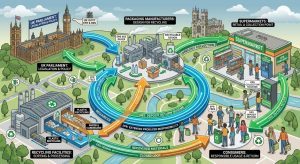
Most of these changes are driven by two newly updated frameworks tracking toward nationwide implementation:
- Extended Producer Responsibility (EPR): This law forces large UK companies (those with an annual turnover of over £2 million supplying more than 50 tonnes of packaging) to pay 100% of the waste management costs for their packaging. (Source: House of Commons Library)
- The Deposit Return Scheme (DRS): Managed by the industry-led group Exchange for Change, this scheme puts a refundable deposit on single-use beverage containers to ensure they are returned directly for high-grade recycling rather than thrown in the bin. (Source: Clarity Environmental)
While the legal reporting requirements for EPR are already active for large businesses, the rollout dates for the high-street DRS are firmly locked in.
The Financial Shift: What This Means for Your Council Tax
Do you know who pays to collect your recycling bin? Until now, the cost of collecting, sorting, and recycling your household packaging—everything from your snack wrappers to your shampoo bottles—was paid for by your local council tax. This includes the fuel for bin lorries, the wages of collection crews, and the electricity needed to run recycling plants. (Source: House of Commons Library)
Under the new EPR (Extended Producer Responsibility) system, the rules are flipping. Brands are now required to pay the full cost of the packaging they put onto the market. (Source: GOV.UK)
How this affects you and your household bills: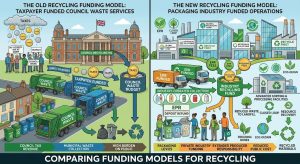
- Taxpayer Relief: By shifting the bill to the companies making the packaging, your Council Tax no longer carries the full weight of rising waste management costs. It removes an estimated £1.2 billion in annual waste management liabilities from local council balance sheets, freeing up public funds for other regional services. (Source: House of Commons Library). We hope this will be reflected in the council tax bills for residents and you can raise this with your local MP!
- Industry-Funded Recycling: The money needed to run recycling plants and sort materials is shifting from local household taxes to industry fees. The brands creating the waste now foot 100% of the bill for their disposal through direct local authority reimbursement schemes. (Source: GOV.UK)
- A “Green” Incentive: Because brands now have to pay for the waste they create, they are financially motivated to make their packaging easier (and cheaper) to recycle. This competition pushes them toward simpler materials, which keeps costs lower for the entire recycling network. (Source: Clarity Environmental)
Why this is a positive change for the public:
In short, you are no longer subsidising the waste management of major corporations. Previously, if a company chose cheap, non-recyclable plastic, you paid the local council to clean it up. Now, the company pays. While this won’t show up as an immediate cash refund on your council tax bill, it helps protect council budgets from future tax hikes by making sure multi-million-pound corporate waste bills are paid by the corporate world, not local communities. (Source: Builders Merchants Federation)
The European Blueprint: Proven Success Beyond Borders
If you want to see the future of UK recycling, look across the Channel. These upcoming UK frameworks closely model established European programs. Over 18 EU Member States now operate active Deposit Return Schemes, demonstrating how a localized “polluter pays” strategy completely transforms national waste management networks. (Source: Ecomondo)
The dual impact of these systems yields massive environmental and operational insights across three key case studies:
| Country Focus | System Rules & Setup | Waste Management & Recycling Effects | What It Proves for the UK |
| Germany (The Mature Model) |
Rules: Flat 25c deposit on single-use plastics, aluminum, and glass. Scope: Includes carbonated drinks, beer, and water; excludes milk and spirits. (Source: TOMRA) |
The Effect: Achieves a massive 98% return rate via nationwide Reverse Vending Machines (RVMs). Landfill diversion is so absolute that less than 1% of total municipal waste is buried. | A persistent, straightforward financial incentive entirely normalises eco-responsibility over time, removing litter from public landscapes permanently. |
| Lithuania (The Fast Tracker) |
Rules: Flat 10c deposit across PET plastic and cans. Scope: All beer, cider, and soft drinks. Managed by a centralized non-profit operator. (Source: Sensoneo) |
The Effect: Witnessed an astonishing collection rate leap from a baseline of 34% to over 92% within just 18 months of launching infrastructure. | Modern DRS infrastructure can drastically alter public recycling habits and clean up regional landscapes almost overnight if backed by clear retail execution. |
| Ireland (The Modern Blueprint) |
Rules: Tiered deposit system (15c for containers up to 500ml; 25c for over 500ml). Scope: PET plastic and metal cans. Excludes glass and dairy. (Source: Citizens Information) |
The Effect: Plastic bottle recycling rates surged from 49% to over 90%. Collected material streams reach purity levels of 98%, paving the way for true bottle-to-bottle circular manufacturing. (Source: The Journal) |
Separate container return pipelines prevent food and general waste contamination, creating the clean, high-value material streams needed to meet strict green regulations. |
Key UK Recycling Policy Timelines
- 2025: Large brands began mandatory semi-annual reporting of household packaging weights under EPR. (Source: House of Commons Library)
- 2026: Official DRS registration opens for all drinks producers, importers, and retailers in Q3. (Source: Clarity Environmental)
- 2027: The official Deposit Return Scheme (DRS) launches across England, Scotland, Wales, and Northern Ireland on 1 October. (Source: Veolia UK)
- 2031: The transitional exemption for glass bottles in Wales ends, integrating glass fully into the Welsh DRS system. (Source: Clarity Environmental)
5 Things UK Shoppers Will Notice First at the Till
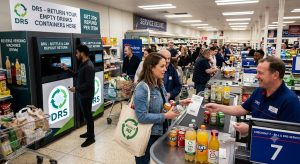
When you step into a supermarket or local shop after the October 2027 DRS launch, your shopping routine will look and feel noticeably different. Here is what to expect:
1. Mandatory DRS Logos on Drinks
Every single-use beverage container in scope—including PET plastic bottles, aluminium cans, and steel cans between 150ml and 3 litres—must feature a highly visible, approved DRS logo. If a container doesn’t have the mark, it can’t be scanned for a refund. (Source: Ecosurety)
2. A 20p Deposit Added to the Price
When you pick up a can of soda or a bottle of water, you will pay a flat 20p deposit on top of the retail price. This isn’t a tax; you get every penny back when you return the intact, empty container. (Source: Clarity Environmental)
3. The Arrival of Reverse Vending Machines (RVMs)
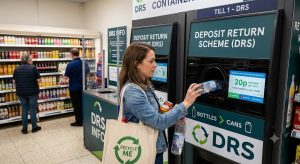
Supermarkets and high-street retailers will become active return hubs. You will see automated Reverse Vending Machines installed at shop entrances where you insert your empty cans and bottles to receive a cash refund voucher or digital payout. Smaller shops may offer manual over-the-counter returns. (Source: Compact and Bale)
4. A Border Split on Glass Bottles
If you live in England, Scotland, or Northern Ireland, your glass wine, beer, and spirit bottles are excluded from the DRS and will still go into your standard kerbside recycling. However, Wales includes glass. Welsh shoppers will eventually pay deposits on glass, while a 4-year label exemption runs from 2027 to 2031 to give the supply chain time to adapt. (Source: Veolia UK)
5. Stripped-Back, Monomaterial Packaging
Because EPR penalizes brands with higher fees for using hard-to-recycle or mixed materials (like plastic windows on cardboard boxes or plastic-lined pouches), companies are rapidly redesigning their packaging. Expect simpler, single-material wrappers and fewer multi-layered plastics on your supermarket shelves. (Source: Clarity Environmental)
How to Prep Your Household Recycling Routine
While the DRS system will be uniform nationwide starting in 2027, it is critical to remember that your local council kerbside rules will still vary for items outside the scheme (like food trays, cardboard, and jars).
Before setting up your new routine, review how standard domestic collections interact with the new 20p DRS rules:
| Material / Item Type | DRS Action (October 2027) | Standard Council Kerbside Rule |
| PET Plastic Bottles & Drink Cans | Do Not Crush. Save them completely intact with legible barcodes to return to store RVMs for your 20p refund. | Can still be placed here if you choose to forfeit your 20p deposit back to the council system. |
| White HDPE Plastic Milk Bottles | Excluded from DRS. No deposit applied. | Wash, squash, and leave the lids on. Always accepted by 100% of UK local councils. |
| Glass Drink Bottles | Wales Only: Return to DRS hubs.
Rest of UK: Excluded from DRS. |
Check locally. Most councils collect glass directly via bins, but some regions still require you to use local bottle banks. |
| Cardboard & Food Cartons (Tetra Pak) | Excluded from DRS. | Check locally. While cardboard is universally accepted, some rural councils still require food cartons to go into general waste. |
Simple Routine Checklist:
1. Stop crushing your cans and plastic bottles: At the point of consumption.
Reverse Vending Machines rely on reading the barcode and shape of the container. If a can is flattened or the label is torn, the machine will reject it, and you will lose your 20p deposit.
Set up a ‘DRS Only’ bin at home: Daily storage.
Keep your plastic bottles and aluminium cans separated from your standard household kerbside recycling bin so you can easily take them back on your next supermarket run.
2. Audit your local council webpage: Monthly adjustment.
Look up your specific borough’s guidelines for non-DRS items like plastic film and food punnets, as municipal handling capabilities remain highly localized.
3. No Deposit Refund outside the UK: Travel organisation.
Consider that taking containers included in the UK’s DRS into other countries, where they would not be recognised, would mean you’d not get the deposit refunded there.
The Retailer & Brand Angle: Keeping Customers Confusion-Free
For green brands and independent retailers, clear communication is critical to prevent friction at the checkout when these price changes occur.
Under EPR rules, brands must design containers that achieve optimal circular recycling paths to avoid high fee penalties. For retail locations acting as return points, the scheme offers a Return Handling Fee (3p per container for manual returns and a tiered layout up to 5p for automated RVM machines) to help offset operating and installation costs. (Source: Clarity Environmental)
The Compliance Connection: To avoid customer frustration, retail signage should explicitly break down the shelf price vs. the 20p deposit fee. Reassuring shoppers that the 20p is fully refundable prevents “sticker shock” at the till.
If you are a UK eco-startup, packaging innovator, or community group leading the way in zero-waste refill stations, we’d love to hear from you.
Share your latest UK data, insights, or retail sustainability trends to help inform and strengthen the conversation around recycling policy.
Get in touch to contribute your insights, tips, and thoughts.

Author Profile

- Always on the hunt for the latest green living news, tips and stories, proudly sharing them with readers all around the world to make this planet a better place.
Latest entries
 DictionarySeptember 3, 2026What Is Biodiversity Net Gain (BNG) in the UK? A Guide to Nature-Positive Development
- DictionaryJuly 10, 2026What Is the UK Deposit Return Scheme (DRS) & Extended Producer Responsibility (EPR)?
- Green News ReleasesApril 22, 2026BRK Tech Reports EU Agriculture Commissioner Hansen Backs Biofuel Boost for Farmers
- Green News ReleasesApril 17, 2026BRK Technology Tackles Energy Crisis with Biofuel Revolution



Leave a Reply
You must be logged in to post a comment.