
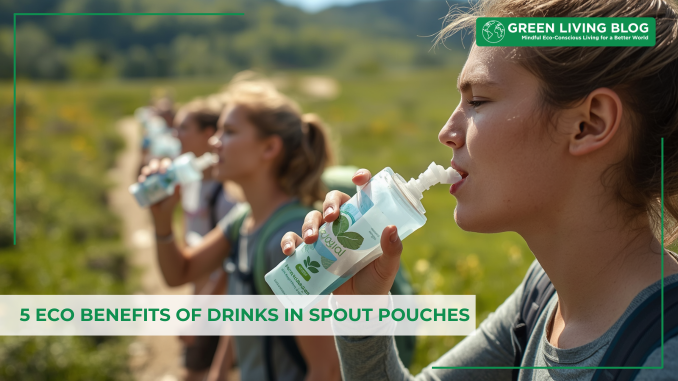
As people prepare for more outdoor adventures, music festivals, or holiday trips during the spring and summer season, selecting the right gear is a key consideration to make it fun and effortless.
While many focus on choosing the right equipment or clothing, the choice of beverage packaging carries more environmental weight than thought.
Heavy glass bottles and rigid plastic cylinders are increasingly being replaced by lightweight, flexible alternatives. That’s where spout pouches—flexible bags constructed from layered film equipped with a re-sealable plastic nozzle—come in as they are modernizing on-the-go hydration.
Beyond their practical convenience, these pouches offer notable environmental advantages.
Below we reveal five ecological benefits of using spout pouches for the mobile beverage needs of those looking to stay hydrated with a lower environmental footprint.
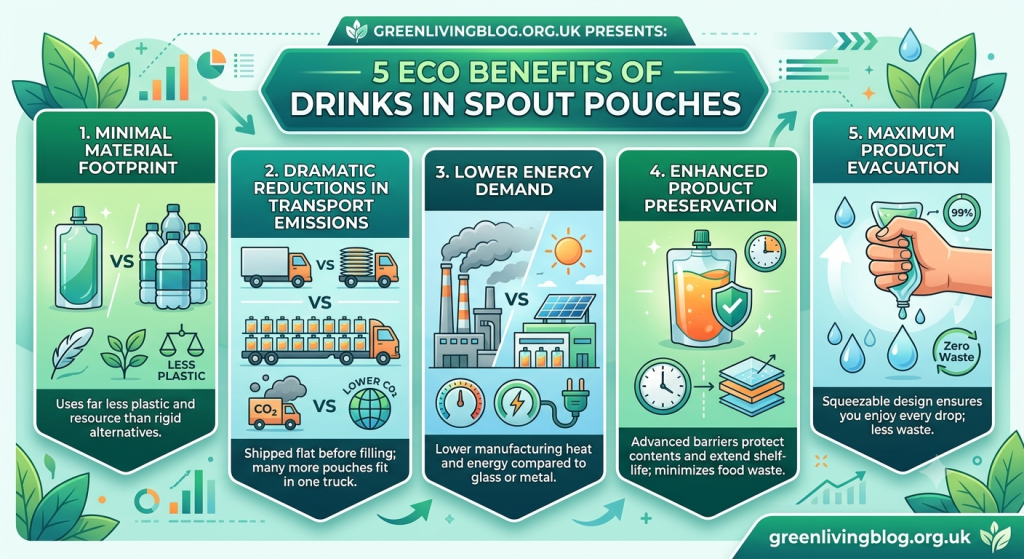
1. Minimal Material Footprint
The primary environmental benefit of a spout pouch lies in its structural efficiency. Other containers require substantial material volumes to maintain structural integrity whereas flexible pouches achieve use a fraction of that mass.
According to comprehensive Life Cycle Assessments (LCAs) evaluating various liquid containment formats, lightweight flexible plastic systems consistently outperform rigid alternatives across most environmental impact categories due to their low raw material requirements.
A standard spout pouch uses up to 60–70% less plastic than a conventional rigid PET bottle of the equivalent volume, reducing excess waste significantly.
2. Drastic Reductions in Transport Emissions
Shipping empty packaging components or moving finished products across distribution networks incurs high carbon costs. Rigid containers do not compress; a transport truck moving empty glass bottles or aluminium cans is essentially hauling a high volume of trapped air.
Spout pouches lay completely flat before they are filled. A single standard shipping container can carry up to ten times more empty pouches than empty glass or rigid plastic bottles. This logistical advantage drastically lowers the number of trucks needed on road networks, cutting freight-related greenhouse gas emissions and reducing transport energy usage.
3. Lower Energy Demand During Manufacturing
Shaping materials like glass or aluminium requires extreme heat. Smelting aluminium requires temperatures exceeding 600°C, while forming glass demands furnaces running upwards of 1400°C.
The fabrication of multi-layered flexible films operates at significantly lower thermal thresholds. Because the production phase heavily influences a container’s overall lifecycle footprint, the lower energy consumption used to manufacture flexible pouches translates directly into reduced fossil resource dependency and diminished industrial carbon output.
4. Enhanced Product Preservation Reduces Food Waste
Packaging functions as a vital defence mechanism to protect food and beverage products, extending shelf-life and mitigating household food waste. Food production carries a heavy carbon cost, making waste reduction a core strategy for lowering total environmental impact.
The advanced barrier films used in high-quality pouch construction protect contents against moisture, UV light, and oxygen ingress. Furthermore, as liquid is consumed from a pouch, the structure collapses. This minimizes the internal headspace and limits the amount of oxygen in contact with the remaining beverage, keeping juices, cocktails, or water fresh for longer periods without relying heavily on artificial preservatives.
5. Minimal Product Waste
Have you ever tried to get the last drops out of a rigid bottle or carton? A considerable amount of liquid often remains trapped inside corners or stuck to rigid walls, eventually ending up in the trash.
The flexible, squeezable architecture of spout pouches allows users to extract up to 99% of the internal liquid, ensuring that almost no product is wasted.
Drink Containers Tailor-Made for Life on the Move
Beyond their environmental benefits, spout pouches are uniquely suited for dynamic, active lifestyles.
When evaluated alongside traditional containers, they present distinct advantages for users on the go.
| Feature | Spout Pouches | Rigid Bottles / Glass |
| Weight | Extremely ultra-lightweight | Heavy, adding to pack weight |
| Safety | Shatterproof and flexible | Risk of breakage or injury |
| Space Efficiency | Collapses as you drink | Occupies fixed volume when empty |
| Portability | Packable and pocket-friendly | Bulky and rigid |
Who can Benefit from Drinks in Spout Pouches?

- The Festival Goer: Major outdoor music festivals enforce strict “no glass” policies for safety reasons. Spout pouches are completely shatterproof, flexible, and safe for crowded venues. They slide easily into front packs or belt bags, providing a hassle-free and lightweight way to carry hydration around.
- The Wilderness Hiker: For multi-day treks, managing pack weight and volume is vital. A spout pouch provides durable containment on the trail and compresses down to the size of a small wallet once emptied. This eliminates the burden of carrying bulky, empty containers across miles of terrain.
- The Commuter & Traveler: Navigating airports, bus or train transits while staying hydrated can be challenging, especially with carry-on liquid restrictions. Drinks in spout pouches make it easy to prevent accidental spills inside bags, while their flexible form easily conforms to tightly packed carry-ons or glove compartments.
Balancing the Eco-Equation
While flexible pouches drastically outperform traditional packaging in material reduction, carbon emissions, and production energy, processing them at end-of-life still requires attention. Multi-layer laminate films demand specialised handling to separate the polymer layers during recycling.
Fortunately, packaging infrastructure is advancing rapidly, with expanded localized collection programs and chemical recycling technologies—such as pyrolysis—designed to efficiently process mixed plastic streams back into high-quality raw materials.
Elliot Hyams, Director at SPS Pouches, explains:
“Refill pouches are one of the most direct ways for brands to reduce packaging weight versus rigid formats, but spouted refills have been difficult to deliver in mono-material PE without compromising on performance. We’ve invested in getting the process window right so growing brands can access a refill format that’s commercially practical and aligned with where the industry is heading.”
For eco-conscious consumers looking to reduce their active carbon footprint, shifting from heavy, material-dense rigid containers to streamlined spout pouches represents a highly practical step toward everyday green living.

Author Profile

- Online Media & PR Strategist
- Blogger and Educator by Passion | Senior Online Media & PR Strategist at ClickDo Ltd. | Fascinated to Write Lifestyle Blogs in News & Education I have completed a journalism summer course at the London School of Journalism and manage various blogs.
Latest entries
 Green Home GuidesAugust 19, 2026Top 10 Eco Kitchen Accessories & Sustainable Alternatives
- UncategorizedAugust 7, 2026How Smarter Bin Bag Habits Can Stop Maggots in the Trash Can
- BusinessJune 30, 2026Top 10 Green Brands in the UK Market: Setting the Eco Standard
- DictionaryJune 23, 2026Outdoor Yoga is the “Triple-Win” Wellbeing Habit for the Self + Community + Planet




Leave a Reply
You must be logged in to post a comment.