
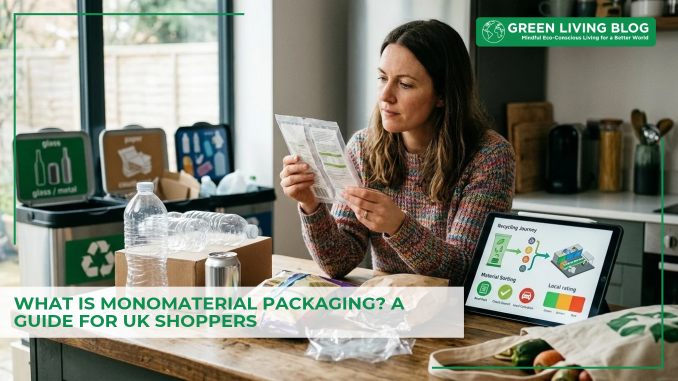
“Mono” means one. So monomaterial packaging is a pack made mostly from one material.
It uses one type of material, not a mix. Most of the time, that material is plastic.
Most packs are the opposite. A crisp packet can use four or five materials at once. There is plastic for strength, foil to keep the air out, a layer to stop grease, and ink for the brand. That mix is what keeps crisps fresh for months.
Here is the important part. Monomaterial tells you what a pack is made of. It does not mean you can put that pack in your recycling at home.
Three things decide if a pack is monomaterial:
- One main material. The pack is made mostly from one plastic, with as little else as possible.
- The right type of plastic. For flexible packaging, that is usually PE or PP. PET is used too, but it is recycled in a different way.
- CEFLEX provides practical design guidance for flexible packaging, covering material selection, recyclability, inks, adhesives, barrier materials and sortability. These are packaging design guidelines, not a UK legal requirement.
Two things surprise people. One material does not mean one layer. A pack can have several layers and still be monomaterial. And paper, card, glass and aluminium can be single-material too. Each one is recycled in a different way.
One thing to watch: A pack that swaps plastic for paper, or just uses less plastic, is a different sustainable packaging option. It is a good idea, but it is not monomaterial.
What Makes Packaging Monomaterial?

Three things are pushing the agenda.
- The pack has to work first. Making simple plastic was never the problem. Keeping food fresh inside it was. That is sorted now, which is why the change has reached your trolley. The next step is a pack that can detect changes in the food while still protecting it. That is the move towards smart packaging.
- Fees reward easy-to-recycle packs. Companies pay a fee for household packaging, and how recyclable the pack is decides how much. Flexible plastic does badly. 61.8% of it got the worst rating, according to industry analysis of the official figures. Plastic costs about £485 a tonne on average, and the red rate doubles by 2028/29.
- Your council has the final say. A brand can pick the simplest pack there is. But if no one collects that plastic, there is no point. That is what Simpler Recycling is meant to fix, by giving England one list of materials to collect.
Together, these three things keep packaging changing long before it reaches you.
Is Monomaterial Packaging Actually Recyclable?
Not automatically. That is what the word “mono” does not tell you.
Sorting machines are good at one job. They can spot types of plastic. What they cannot do is pull a pack apart. So if the layers are stuck together, the pack is thrown away. That plastic then breaks down into microplastics.
Some plastics are still hard to recycle in the UK, and soft plastic is the hardest.
In England, home collections for soft plastic were pushed back to 1 April 2030. Until then, take soft plastic to the supermarket with you.
One rule to remember: Compostable and biodegradable packs must never go in with plastic. They are made to break down, so they cannot be recycled.
What the UK’s New Packaging Rules Mean for Shoppers

The new rules are aimed at companies. But four of them change things for consumers.
- You do not pay the fee. Companies that put packaging on the market pay it. It covers the cost of household packaging waste. Some of that cost can still end up in shop prices.
- Every pack gets a colour. Green means easy to recycle, so it pays the least. Amber is the standard rate. Red means hard to recycle, so it pays the most. The rules are set out in full here.
- Soft plastic collections are still a way off. England wants all councils to collect the same materials. But the date for flexible plastic moved to 1 April 2030.
- A deposit is coming. From 1 October 2027, you will pay a small deposit on drinks bottles and cans. You get it back when you return them at collection points.
Both schemes are explained in our UK Deposit Return Scheme and EPR explainer.
How to Tell What Packaging You Can Recycle
Two checks will settle almost everything in your bag.
1. Read the pack. Most packs carry a recycling label or a short note. Keep the lid on. Lids under 40mm are too small for the sorting machines to catch.
2. Ask your council. Councils collect different things, so this is the check that decides it. If the pack and your council disagree, your council is right.
Do not trust “eco” claims on their own. UK rules say they have to be accurate under the Green Claims Code.
Our guide to product transparency shows how those claims get checked.
| What it is | Where it goes |
|---|---|
| Plastic bottles — drink, shampoo, cleaning | Home recycling bin. Empty, rinse, label and cap on. |
| Soft plastic — wrappers, films, bags | Check your local council or participating retailer for recycling options. |
| Paper and card — sleeves, boxes | Home paper recycling, if your council takes them and they are clean. |
Empty packaging. A half-full container can spoil a whole load of recycling.
Plastic is not one material. PET, HDPE, PP and LDPE are all recycled in different ways. That is why packs carry a number. Clear on Plastics, the WRAP guide, explains why.
Shape matters too. Most councils take plastic bottles. Far fewer take films and pouches. And black plastic is not recycled at all, because the machines cannot see it.
Paper is not always better. Paper food packaging usually has a plastic lining. A parliamentary inquiry found that a coffee cup is paper glued to a 5% plastic lining. That is why cups do not go in your paper bin. Paper glued to plastic, like crisp tubes, cannot be separated either. So it acts like any mixed pack.
What This Means for Your Weekly Shop
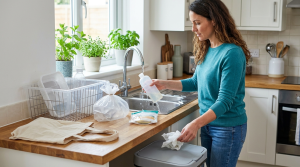
Five everyday items, and what to do with each one.
- Pouches: Often made from several layers. Some can be recycled; check your local council recycling terms.
- Delivery bags: These are made of soft plastic and supermarkets may take them back after the delivery.
- Toiletries: Plastic bottles of shampoo, shower gel and cleaning products go in your home recycling. Rinse them first.
- Wipes: Used wipes should go in the general waste, never flush them down the toilet.
If you want more information on services offering waste collections, our round-up of green waste collection services is a useful companion.
Your checklist for monomaterial recycling 2026, in this order:
- Material. Is it one plastic or a mix? Materials are not simply interchangeable.
- Instructions. What does the pack tell you to do?
- Local collection. Will your council take it?
- Reusability. Can you refill it? Find refill points near you.
- Packaging reduction. There are simple ways to cut the plastic you bring home.
So the habit change is straightforward. Look at the material. Read the pack. Then check with your council. A well-designed pack in the wrong bin is still rubbish. And that rubbish breaks down into microplastics. There are simple ways to reduce microplastics at home.
If you have insights or tips on recycling to share, get in touch.
There is more on packaging and sustainability trends in our Trendspotter hub.

Author Profile

- Passionate content creator, contributor, freelance writer and content marketing allrounder.
Latest entries
 DictionaryOctober 1, 2026What Is Monomaterial Packaging? A Guide for UK Shoppers
- EnvironmentJune 8, 2026The UK’s Most Sustainable Building Materials Ranked
- Green Expert GuidesMay 4, 2026Beyond the Delete Button: Why Secure Hard Drive Shredding is the most Sustainable Data Safeguard
- Green Expert GuidesMarch 28, 2026The Environmental Cost of IT Hardware — Why Server Recycling Matters



Leave a Reply
You must be logged in to post a comment.