
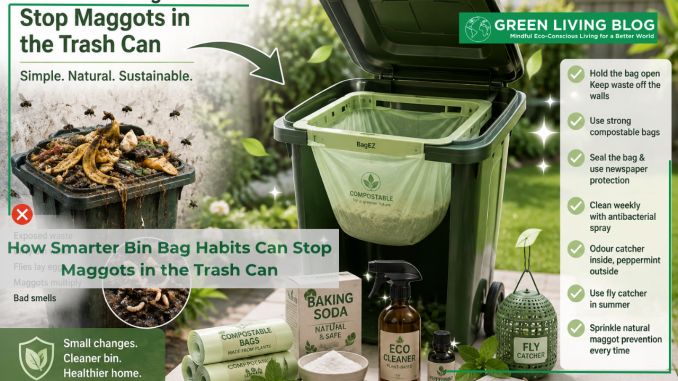
Maggots crawling all over your wheelie bin is the one sight nobody wants to see. And it’s because the horror of the cleanup coming becomes clear.
So, let’s get started, making sure we avoid getting into this nightmare situation while using natural and sustainable methods that align with green waste management habits.
But to do that, we first need to know what causes maggots so we can prevent them.
Why do we get maggots in the wheelie bin?

The smell from a dirty bin attracts flies that lay eggs on wet waste they can smell and reach. The reason they can smell and reach it is that the waste has already smeared over the walls of the bin. The filthier a bin is, the more flies it draws in than a cleaner one.
But when you scrub it out on Sunday, you’re back to square one by Wednesday. Washing a bin gets frustrating. But it shows us that without a bin liner, we as homeowners are going to be doing a lot of bin washing. Liners prevent messy waste from cooking in the hot sun and from turning bins gross.
Liners are a super simple way to keep bins clean, but most don’t use them. There are cost and availability factors to consider. Many feel that lining a bin with a huge bag to contain the small amount of waste they put out weekly makes no sense and is a waste of money.
However, even with liners, maggots turn up because liners stop bins from getting dirty, not flies. Even when used with powders and solutions to prevent maggots, the large opening requires much more of these fixes to be effective and achieve the desired outcome.
Do more with less concept
So, a more effective alternative is to keep the waste sealed in a smaller, contained space to make the applied solutions more effective and to prevent rotting waste from touching the bin, which would make it dirty and smelly.
If we keep these goals, preventing maggots becomes easier. Here is the easiest tested method to prevent maggots.
These seven steps take less than a minute each week and cost less than a pound in materials. But for the best results, start with a clean bin.
If yours is already coated, give it one proper wash first, then keep it that way with the routine rather than repeating the wash every fortnight.
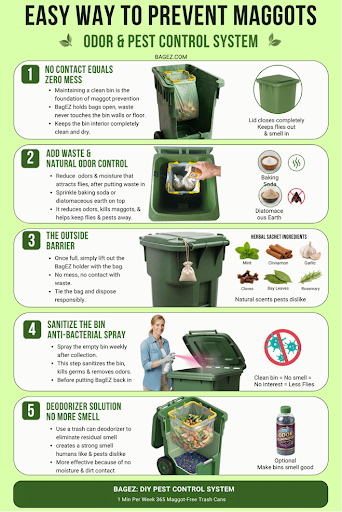
Tip 1: Hold the bag open so the waste never touches the bin
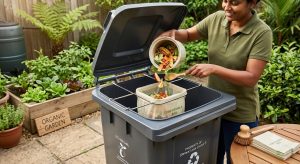
This is the one that makes the other six easy.
A trash bag holder like BagEZ (bagez.com) hooks over the rim of your bin and holds a small compostable bag open underneath the lid. Food scraps drop straight into the bag. Nothing hits the sides, nothing pools in the bottom, and the bag stays open and upright instead of collapsing in on itself the moment you close the lid.
The frame keeps an air gap all the way round the bag, so even a full bag isn’t pressed against the plastic. That gap matters more than people expect. Contact is how bins get coated, and coating is how bins get maggots.
If nothing sticks, nothing stinks.
You can use the small compostable liners you’d find in any supermarket rather than sizing up to a big bin liner, which is the other quiet saving here. Small bag, small mess, sealed and gone.
Tip 2: Trust the bag, or don’t bother with any of this

The safety of your bin comes down to whether the bag holds. That’s it.
Always use a brand you trust. A brand that has not failed you over time. A cheaper liner may hold up just as well, but unless you test them you never know. Some bags split at the seam under a bit of weight, or break every other step on this list, and you’ll find out about it three days later when you lift the lid. Buy the ones that hold and check the thickness rating rather than the price per roll.
Tip 3: Seal the bag, and lay a bed of newspaper underneath
Two seconds now saves about ten minutes on collection day. Worth it.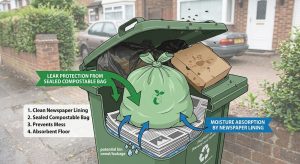
When the bag’s full, release it from the frame and tie it properly. Then, before you drop it in, throw a few sheets of newspaper across the bottom of the bin.
The bag isn’t sitting in there long enough to cause real damage for most weeks. But you’re planning for the week it does. The newspaper works as a bed and a shield between the tied bag and the bin floor, so if there’s any weep from a corner or a pinhole, the paper catches it instead of the plastic. Pull the paper out with the bag on collection day, and the bottom of the bin is still dry.
Tip 4: Spray the lid, the rim and both sides once a week

Antibacterial spray, once a week, right after the bin’s been emptied and before you put the bag holder back to work.
Do the lid, do the rim, and do the inside and the outside. The rim is the bit everybody skips and it’s the bit that touches everything. Germs and lingering smell both live there.
Timing it for straight after collection is deliberate. The bin is empty, it’s the only moment in the week you can reach every surface, and you’re not spraying over a full bag.
Tip 5: Odour catcher inside, peppermint outside
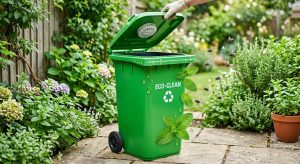
An odour catcher or bin freshener sits inside and pulls the bad smell out, so you get a clean hit of air every time you lift the lid rather than a face full of last Tuesday.
Then work the outside. Peppermint pouches or peppermint oil on the outer surface of the bin do a job the freshener can’t, because flies dislike the smell and tend to keep their distance. You’re making the bin less appealing before a fly ever gets near the lid.
Inside for the odour, outside for the flies. Both take about ten seconds.
Tip 6: Hang a fly catcher near the bin, especially in summer
Flies can’t lay eggs in a bin they never reach.
Hang a fly catcher near or above the bin from late spring through to the end of summer, when the numbers climb. There are plenty of variations on this fix online, from sticky strips to hanging traps to homemade bottle catchers, and which one suits you depends on where your bin lives. A bin tucked in a shaded side alley has a different problem to one standing in full sun by the back gate. Have a look at a couple and pick the one that fits your setup.
Tip 7: Sprinkle something over the waste every time you open the lid

For the flies that still get through.
Every time you open the lid to throw in kitchen scraps, sprinkle a little of one of these over the waste:
- Baking soda
- Salt
- Vinegar
- Diatomaceous earth
All four natural remedies kill maggots on contact and stop a few eggs turning into an infestation. Because you’re doing it inside the bag, whatever’s in there stays in there and goes out with the bag on collection day. Nothing to dig out of the bin afterwards.
Keep the tub next to your kitchen bin rather than out by the wheelie bin. You’ll actually use it that way.
The whole routine, week to week
Nothing here is a project. Once the holder’s on the rim, the weekly version looks like this:
- Collection day: pull the tied bag and the newspaper out together. Spray lid, rim, inside, outside. Fresh newspaper down, clean bag into the holder, odour catcher checked.
- Every day after: sprinkle over the scraps when you open the lid.
- Once a season: replace the fly catcher and top up the peppermint.
That’s the difference between bin cleaning as a weekly job and bin cleaning as something you barely think about. Most people who end up scrubbing a bin out with a pressure washer got there by skipping step one and treating the bin itself as the container. It isn’t. The bag is the container. The bin is just the thing that holds the bag off the ground and keeps the rain out.
Whether you call it wheelie bin cleaning, garbage bin cleaning, or trash can cleaning, depending on where you’re reading this from, the principle doesn’t change with the vocabulary. Contain the waste in the smallest space you can, keep that space off the walls, and the bin stays clean by default.
Get that right and the other six steps take under a minute a week.

Author Profile

- Online Media & PR Strategist
- Blogger and Educator by Passion | Senior Online Media & PR Strategist at ClickDo Ltd. | Fascinated to Write Lifestyle Blogs in News & Education I have completed a journalism summer course at the London School of Journalism and manage various blogs.
Latest entries
 Green Home GuidesAugust 19, 2026Top 10 Eco Kitchen Accessories & Sustainable Alternatives
- UncategorizedAugust 7, 2026How Smarter Bin Bag Habits Can Stop Maggots in the Trash Can
- BusinessJune 30, 2026Top 10 Green Brands in the UK Market: Setting the Eco Standard
- DictionaryJune 23, 2026Outdoor Yoga is the “Triple-Win” Wellbeing Habit for the Self + Community + Planet




Leave a Reply
You must be logged in to post a comment.