
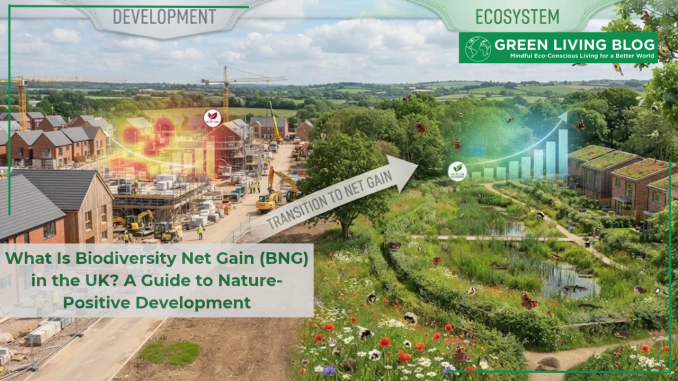
The UK is undergoing a fundamental shift in how construction, housing, and infrastructure projects interact with the natural environment. Central to this transformation is Biodiversity Net Gain (BNG)—a mandatory planning policy framework introduced under the Environment Act 2021 and enacted via amendments to Schedule 7A of the Town and Country Planning Act 1990.
Rather than treating ecological destruction as an unavoidable side effect of economic growth, BNG legally mandates that developers leave local biodiversity in a measurably better state than before construction began.
What Is Biodiversity Net Gain (BNG)?
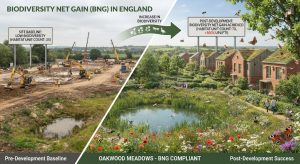
Biodiversity Net Gain is an approach to development and land management that aims to leave the natural environment in a measurably better state than it was previously.
Under statutory rules enforced across England, developers must deliver a minimum 10% net gain in biodiversity units relative to the pre-development baseline. To calculate this score, the UK government introduced the official Statutory Biodiversity Metric, a habitat-based accounting tool developed and updated by Natural England. This metric calculates the ecological value of land based on habitat size, condition, distinctiveness, and strategic location. (Source: Department for Environment, Food & Rural Affairs (Defra))
Is BNG a UK-Wide Requirement?
A common point of confusion in property and environmental planning is whether BNG applies uniformly across all four devolved nations. While the overarching policy drive for nature recovery exists across the UK, the statutory, mandatory 10% BNG market framework specifically applies to England.
| Area | BNG Position & Policy Framework | Primary Reference Source |
| England | Mandatory statutory 10% BNG framework enforced via the Environment Act 2021. | GOV.UK Statutory BNG Guidance |
| Scotland | Operates under National Planning Framework 4 (NPF4), requiring developments to deliver “biodiversity enhancement” without a fixed statutory 10% metric. | Scottish Government Planning (NPF4) |
| Wales | Governed by Planning Policy Wales (PPW 12) and the DECA approach (Net Benefit for Biodiversity), focusing on ecosystem resilience. | Welsh Government Planning Policy |
| Northern Ireland | Evaluated under individual regional strategic planning policies (SPPS), with no mandatory statutory market unit scheme currently enacted. | Department for Infrastructure NI |
Understanding this regional distinction prevents planning delays and ensures developers apply the correct policy mechanisms based on site jurisdiction.
Why Is BNG Necessary in the UK?
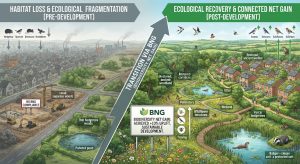
The UK is historically one of the most nature-depleted countries in the world, with species across Great Britain declining on average by 19% since 1970. Nearly 1 in 6 species (16%) are currently threatened with extinction, driven largely by intensive land development and habitat fragmentation. (Source: State of Nature Report / JNCC)
BNG addresses this historic loss by embedding ecological restoration directly into the planning process. In short, developers are no longer permitted to clear greenfield or brownfield land and replace it with concrete without replacing and enhancing those natural assets elsewhere.
Government projections estimate BNG policy will prevent between 6,000 and 10,000 hectares of habitat loss annually—an area roughly the size of Nottingham—while encouraging earlier, nature-led design decisions to support national targets such as net zero. (Source: Defra Environment Blog)
The UK’s 10% Biodiversity Net Gain Requirement
Under statutory rules across England, covered developments must achieve a minimum 10% net gain in biodiversity units relative to the pre-development baseline.
Which Developments Does BNG Apply To?
- Major Developments (Live since Feb 2024): Residential schemes with 10 or more dwellings (or sites over 0.5 hectares) and commercial developments providing 1,000+ sq metres of floor space.
- Small Site Developments (Live since April 2024): Residential developments (1–9 homes) and non-residential builds under 1,000 sq metres (unless falling under small-site exemption thresholds).
- Nationally Significant Infrastructure Projects (NSIPs): Major transport, water, and energy infrastructure projects fall under mandatory BNG requirements starting November 2026. (Source: GOV.UK NSIP BNG Guidance)
The Core Pillars of BNG Compliance
Developers and local planning authorities must follow strict statutory guidelines when preparing site plans:
- Mandatory 10% Minimum Gain: Every covered project must prove a minimum 10% increase in overall biodiversity scores across habitats, hedgerows, and watercourses.
- The 30-Year Rule: Any habitat created or enhanced to meet BNG requirements must be legally secured, managed, and monitored for at least 30 years. (Source: Natural England Statutory Framework)
- The Mitigation Hierarchy: Developers must prioritize avoiding ecological damage first, mitigating impacts on-site second, and utilizing off-site gains or biodiversity credits only as a last resort.
- The National Gain Site Register: Off-site biodiversity gains must be formally recorded on Natural England’s centralized statutory register to prevent double-counting. (Source: Gain Site Register / GOV.UK)
How Is Biodiversity Net Gain Calculated?
Biodiversity is quantified using the official Statutory Biodiversity Metric, an accounting tool managed by Natural England. The metric converts habitats into “biodiversity units” based on several mathematical factors:
BiodiversityUnitValue=HabitatArea(ha)orLength(km)DistinctivenessConditionStrategicSignificanceRiskMultipliers
- Habitat Condition: Evaluated through field surveys assessing species richness, physical health, age structure, and invasive species presence. To understand the baseline groundwork needed before metric calculations start, review our guide on ecological surveys.
- Habitat Condition: Evaluated through standardized field surveys assessing species richness, physical health, age structure, and invasive species presence.
- Extent & Size: Measured in hectares for area habitats, kilometres for linear hedgerows, and kilometres for rivers and watercourses.
- Strategic Significance: Extra unit weighting is assigned if the land aligns with Local Nature Recovery Strategies (LNRS) or local council biodiversity spatial targets.
- Spatial & Temporal Risk Multipliers: Applied to post-development proposals to account for difficulty, time-lag in habitat creation, and distance from the impact site.
(Source: GOV.UK Statutory Biodiversity Metric Guidance)
How BNG Is Delivered: The 3 Delivery Pathways
When a developer submits a planning application, biodiversity gains are achieved through three main routes, strictly following the Biodiversity Gain Hierarchy:
1. On-Site Enhancements (The Preferred Route)
Developers integrate nature directly into their site plans. This includes planting native broadleaf trees, constructing wildflower meadows, restoring existing wetlands, or installing Sustainable Drainage Systems (SuDS). Integrating green spaces on-site satisfies planning rules while creating healthy communities.
To learn more about how sustainable landscaping and natural features transform urban areas, explore our guide to sustainable gardens.
2. Off-Site Biodiversity Units
If a site is too small or restricted to deliver a 10% gain on-site, developers can purchase biodiversity units from external landowners or habitat banks. Farmers and private landowners can convert underperforming agricultural land into nature havens, creating long-term revenue streams by selling units to developers.
For a deeper dive into how habitat creation and ecosystem restoration reduce our national footprint, explore our article on How Biodiversity Conservation and Ecosystem Restoration Help Reduce your Environmental Footprint.
3. Statutory Biodiversity Credits (Last Resort)
As a final fallback, developers can purchase statutory biodiversity credits directly from the UK government. The proceeds are reinvested into national habitat restoration projects, though government credit prices are intentionally set high to discourage over-reliance on this option. Official Defra reporting shows statutory credit sales generated £426,100, which was directly reinvested into off-site habitat purchasing. (Source: Defra BNG Statutory Credit Reports)
What Counts as Biodiversity Gain?
A wide variety of habitat improvements can generate eligible biodiversity units:
- Woodland & Scrub Creation: Planting native broadleaf trees, hedgerows, and mixed scrubland to connect wildlife corridors.
- Species-Rich Grasslands & Wildflower Meadows: Replacing species-poor turf with native grass blends and wildflower habitats that support pollinators.
- Wetlands & SuDS: Constructing attenuation ponds, rain gardens, and vegetated Sustainable Drainage Systems.
- Urban Greening: Green roofs, living walls, and pocket parks embedded directly into urban master plans.
BNG, Property Development & Planning

For developers, BNG shifts ecological planning from an afterthought to a core feasibility consideration:
- Biodiversity Gain Plans: Before planning permission is granted, developers must submit a formal Biodiversity Gain Plan proving how the 10% gain will be achieved.
- Legal Agreements: Long-term habitat management commitments are legally bound through Section 106 obligations or Conservation Covenants enforced by designated responsible bodies.
- The Statutory Register: Off-site habitat units must be formally logged on Natural England’s national Gain Site Register to prevent double-counting across developments.
Sustainable construction methods work hand-in-hand with BNG. To see how low-impact options complement nature-first sites, read our analysis on building materials or review our guide on biodegradable building materials.
BNG Regulatory Updates & Future Trends
The UK government continuously refines BNG regulations to balance ecological impact with development speed:
- 0.2-Hectare Exemption: Planning applications for developments of 0.2 hectares (2,000 square metres) or below are exempt from mandatory BNG, provided no priority habitats are affected. This removes survey burdens on minor urban sites. (Source: Defra Regulatory Amendments Update)
- Relaxed Hierarchy for Minor Developments: Non-exempt minor developments can evaluate on-site creation and registered off-site units simultaneously, allowing small builds to utilize off-site gains immediately without proving on-site impossibility.
- Temporary Land Reinstatement Exemption: Temporary developments where land is reinstated to its former condition within 5 years or less are exempt from mandatory BNG calculations (unless priority habitats are disturbed).
- Infrastructure Integration: From November 2026, Nationally Significant Infrastructure Projects (NSIPs) will fully enter the BNG system under a streamlined framework tailored to linear infrastructure.
Homeowners and local communities looking to complement local developments with domestic habitats can read our guide to natural gardens.
Can Biodiversity Net Gain Really Help Nature?
BNG represents one of the most ambitious legal frameworks for ecological restoration in Europe. By binding private development capital to long-term habitat expansion, it provides sustained funding for UK landscape restoration over 30-year horizons.
However, long-term success relies heavily on enforcement. Local Planning Authorities (LPAs) must have the ecological expertise to audit site submissions, enforce 30-year management agreements, and verify that off-site habitat banks deliver genuine, species-rich biodiversity over decades.
When combined with local nature recovery strategies and sustainable building choices, BNG offers a structural route toward rebuilding Britain’s natural habitats and boosting climate resilience.
If you are a UK developer, ecologist, planning consultant, or local authority specialist navigating the new Biodiversity Net Gain landscape, we’d love to hear from you.
Share your latest UK project data, case studies, or planning insights to help inform and strengthen the conversation around nature-positive development policy.
Get in touch to contribute your insights, tips, and thoughts.

Author Profile

- Always on the hunt for the latest green living news, tips and stories, proudly sharing them with readers all around the world to make this planet a better place.
Latest entries
 DictionarySeptember 3, 2026What Is Biodiversity Net Gain (BNG) in the UK? A Guide to Nature-Positive Development
- DictionaryJuly 10, 2026What Is the UK Deposit Return Scheme (DRS) & Extended Producer Responsibility (EPR)?
- Green News ReleasesApril 22, 2026BRK Tech Reports EU Agriculture Commissioner Hansen Backs Biofuel Boost for Farmers
- Green News ReleasesApril 17, 2026BRK Technology Tackles Energy Crisis with Biofuel Revolution


Leave a Reply
You must be logged in to post a comment.